HealthCare
September 1, 2026
Hospital MEP Planning in India: A Practical Guide for Project Teams
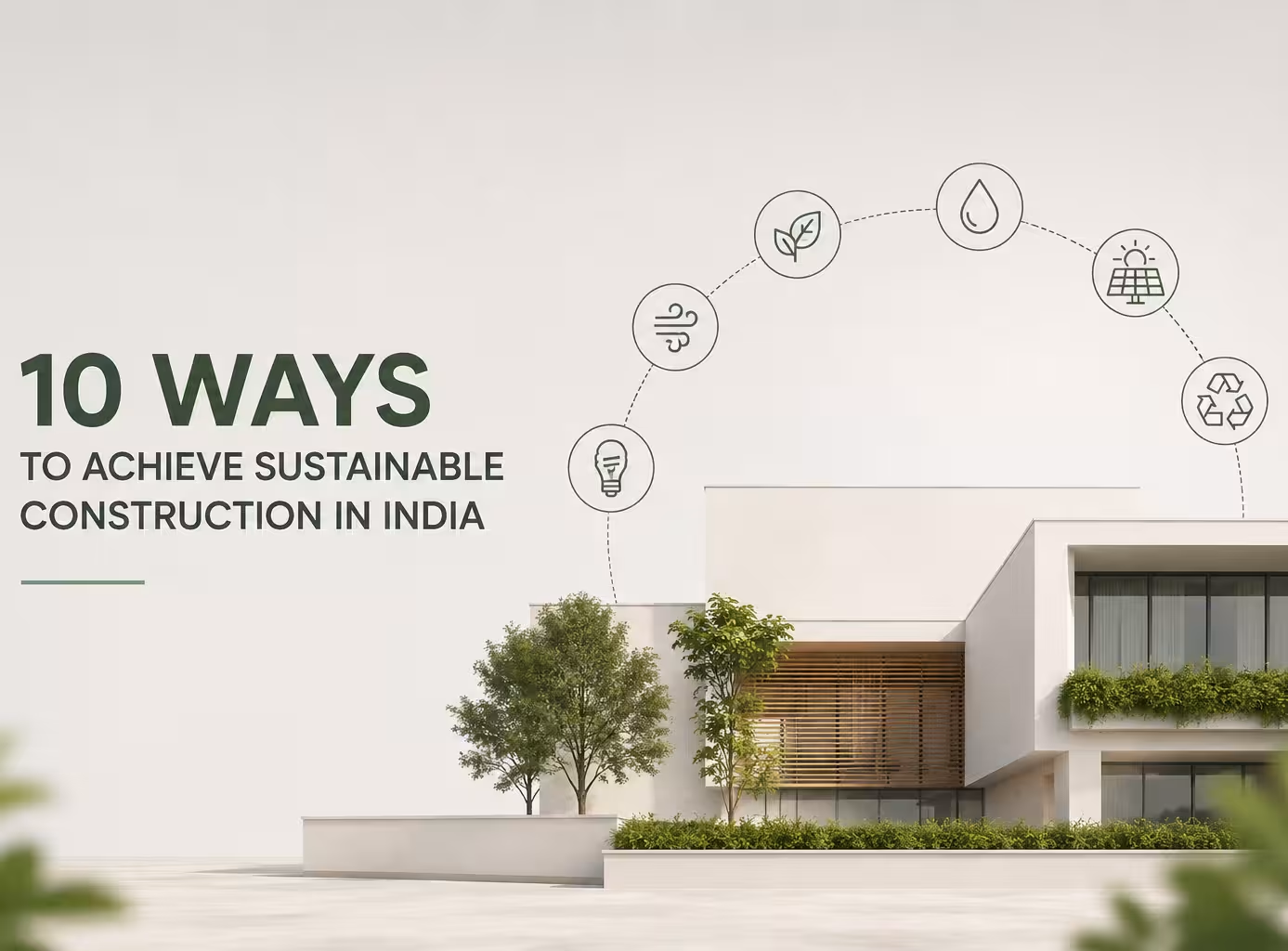
Most institutional building projects start the sustainability conversation too late. By the time a design team is engaged, the site layout is fixed, structural decisions are made, and the building's orientation is locked. At that point, sustainability becomes a documentation exercise rather than a performance outcome.
For hospitals, educational campuses, and NGO-funded projects in India, sustainable construction is a planning discipline — one that directly affects energy bills, water usage, maintenance burden, and long-term operating cost. When integrated early, it improves building performance without necessarily inflating capital cost.
This guide is for institutional decision-makers — trustees, CFOs, hospital boards, campus administrators, and NGO leaders — who want to understand which sustainable construction practices are worth pursuing, when those decisions need to be made, and how to prioritise them within a realistic project context.
Sustainable construction in India refers to planning, designing, and constructing buildings that use energy, water, materials, and land more efficiently while improving long-term operational performance. For institutional projects such as hospitals, campuses, and NGO facilities, the goal is to reduce lifecycle costs while creating healthier and more resilient buildings.
The cost of running a building over its useful life — typically 30 to 50 years for institutional facilities — often exceeds the cost of building it. Energy, water, maintenance, and repair expenditures accumulate every year. A building designed without attention to thermal performance, water efficiency, or material durability will carry those costs indefinitely.
Sustainable construction in India is not an environmental aspiration separate from project economics. It is a way of designing buildings that perform better and cost less to operate.
Hospitals: Hospitals operate 24 hours a day, continuously. HVAC, lighting, medical gas systems, and water supply run without interruption. Energy costs in a poorly designed hospital can become one of the largest recurring operational expenses. Sustainable design choices — passive cooling, efficient HVAC specification, water recycling, and envelope performance — have direct financial impact on those costs, as well as measurable effects on infection control, indoor air quality, and patient recovery environments.
Educational Campuses: Campus buildings must serve students and faculty across decades of changing use. A building designed for flexibility, natural light, and passive ventilation requires less retrofitting over time. Water and energy costs across a campus with hostels, labs, canteens, and academic blocks accumulate significantly. Sustainability decisions made at the master planning stage have compounding benefits across the entire facility.
NGOs and Donor-Funded Infrastructure: For NGOs and CSR-funded projects, sustainability carries an additional layer of accountability. Many institutional funders in India and internationally now expect projects to demonstrate responsible use of resources. A sustainable building is also a lower-maintenance building — which matters for organisations that may have limited facility management capacity after construction is complete.
The single most effective sustainability decision is timing — making it early.
Before structural drawings begin, the project team should address orientation, building massing, shading strategy, natural ventilation, and services design philosophy. These decisions add little or no cost when made at concept stage. They become significantly more expensive — in both time and money — if introduced after detailed design has begun.
Hospital boards and campus committees often treat sustainability as a design or construction responsibility. For institutions, it is a planning responsibility. Once a site layout is fixed, the range of passive design options narrows considerably.
Questions to ask before design begins:
India has a significant climate advantage that institutional projects consistently underutilise: strong passive design potential across most regions.
Passive design uses building form, orientation, shading, natural ventilation, and thermal mass to reduce energy demand — before adding mechanical or electrical systems. It is the most cost-effective layer of sustainable construction because it reduces the load that technology must manage.
For institutions, this means:
The error many institutional projects make is designing the building envelope first and specifying the energy system afterward. The more effective sequence is to minimise the energy load through passive means, then size the mechanical systems to meet that reduced demand. This approach typically results in smaller, lower-cost systems — and lower operating costs over the building's life.
Energy is typically the largest recurring operating cost in institutional buildings — particularly hospitals and large campuses.
Building energy performance depends on decisions made at multiple levels:
For campus projects, corridor and outdoor lighting, hostel common areas, and administrative buildings offer efficiency gains that are relatively straightforward to implement and maintain.
Water stress is a reality across many parts of India. For hospitals and campuses with hostels, water demand is significant, continuous, and rising in cost.
Effective water design goes beyond fitting low-flow fixtures. It requires thinking across the full water cycle from the outset:
For hospitals, water supply continuity is also an operational risk management issue. Municipal supply reliability varies significantly across Indian cities and towns, and institutional water planning should account for this.
Material selection is one of the most consequential and least well-understood sustainability decisions in institutional construction.
The more useful frame than "eco-friendly materials" is lifecycle performance: how does this material perform over 20 to 30 years in terms of durability, maintenance requirement, and replacement cost?
For institutional projects in India:
For hospitals, material selection also intersects with infection control. Surface impermeability, ease of cleaning, and resistance to moisture damage are performance requirements that must be weighed alongside sustainability considerations.
Construction waste is an underappreciated cost on institutional projects. Material waste from poor planning, inaccurate estimation, and on-site mismanagement represents both financial loss and avoidable environmental impact.
Practical waste reduction measures:
For donor-funded NGO projects, waste reduction also relates to accountability. Materials procured and wasted are resources that did not reach the intended project outcome — and that are increasingly difficult to justify to institutional funders.
Institutional buildings rarely serve a fixed brief for their entire life. Hospitals expand departments. Campuses add facilities. NGO programmes scale or shift over time.
A building designed with no provision for future adaptability becomes a significant planning problem when change arrives. Structural systems, floor-to-floor heights, services routing, and vertical circulation all affect how easily a building can be modified or expanded — and at what cost.
Designing for adaptability is a sustainability decision because it extends the useful life of the building and reduces the need for costly retrofitting or demolition.
For hospitals, this might mean designing structural spans that can accommodate future ward reconfiguration or the installation of imaging equipment. For campuses, it might mean planning services infrastructure to support future buildings rather than treating each block as an isolated project.
Rooftop solar has become more accessible in India, and for many institutional projects it is a viable long-term investment. It is not, however, the starting point for sustainable energy design.
The correct sequence is:
An institution that installs solar on a thermally inefficient building with oversized HVAC is spending capital on generation capacity that good building design would have partially avoided.
For hospitals with continuous power requirements, rooftop solar can complement grid supply and reduce tariff exposure. For campuses, solar on hostel roofs, parking canopies, or open spaces can offset lighting and common area loads.
Net metering policies vary by state and are updated periodically. Before factoring energy export revenue into project financials, confirm the applicable policy with the relevant state electricity regulatory authority.
Green building certification is a measurement framework. When used well, it can improve design quality, document performance, and signal institutional commitment. It is not the goal of sustainable construction.
In India, the main certification frameworks available to institutional projects are:
When certification adds value:
When certification may not be the priority:
Certification should validate good design — not substitute for it.
Sustainability goals are frequently eroded in the gap between design intent and construction execution.
An architect specifies a product. A contractor substitutes it. An MEP engineer designs a system that is not coordinated with the building envelope. A procurement decision prioritises upfront cost without considering lifecycle performance. Each of these disconnects is a point where sustainability outcomes are reduced.
The design-build model, where design and construction responsibility are held by a single team, reduces these gaps. When the team responsible for specifying sustainability measures is also responsible for executing them, alignment is structurally more reliable.
For institutional projects, this also simplifies accountability. Rather than managing a conflict between an architect who designed for sustainability and a contractor who executed against a different priority, the institution has a single point of responsibility for delivering the outcomes agreed at the start of the project.
Starting the sustainability conversation after design is underway. At this stage, passive design options are largely foreclosed. Sustainability becomes a specification add-on rather than a performance foundation.
Treating certification as the deliverable. Institutions that pursue certification without embedding sustainability into design often achieve the rating but not the performance.
Focusing on individual products rather than system integration. Sustainability measures work as a system. A solar panel on an inefficient building, or a rainwater harvesting tank without adequate storage sizing, does not deliver meaningful benefit.
Ignoring lifecycle cost. A material that costs less upfront but requires frequent replacement or increases maintenance burden may be more expensive over the building's life. This framing should be built into the feasibility assessment, not added later.
Underestimating commissioning. An energy-efficient HVAC system that is incorrectly commissioned or poorly maintained will deliver neither the efficiency nor the comfort it was specified for. Commissioning is a sustainability decision, not a handover formality.
Sustainability investment should be evaluated the same way any infrastructure investment is: against the long-term operating benefit it produces.
The questions boards and infrastructure committees should ask at project inception:
Q1. Does sustainable construction cost more?
Not necessarily. Many sustainable strategies, such as proper building orientation, shading, and natural ventilation, can be implemented with little additional cost when planned early. While some systems may increase upfront investment, they often reduce energy, water, and maintenance expenses over the building's lifecycle.
Q2. When should sustainability planning begin?
Sustainability planning should begin at the project inception stage. Early decisions about site planning, building orientation, and system design have the greatest impact on long-term energy efficiency, water performance, and operating costs.
Q3. Can hospitals benefit from sustainable construction?
Yes. Hospitals consume large amounts of energy and water, making sustainable design highly valuable. Efficient HVAC systems, water management strategies, and passive design measures can reduce operating costs while improving occupant comfort and wellbeing.
Sustainable construction is most effective when it is considered from the very beginning of a project—not as a certification requirement, but as a strategy for improving long-term building performance. For hospitals, campuses, and NGO facilities, early decisions around design, materials, energy, and water management can significantly reduce operating costs while creating infrastructure that remains efficient and resilient for decades.
BuiltX helps hospitals, educational institutions, and mission-driven organisations integrate sustainability into every stage of design and construction. If you're planning a new facility or campus expansion, connect with our team to explore practical, cost-effective sustainability strategies tailored to your project.