Construction
October 13, 2026
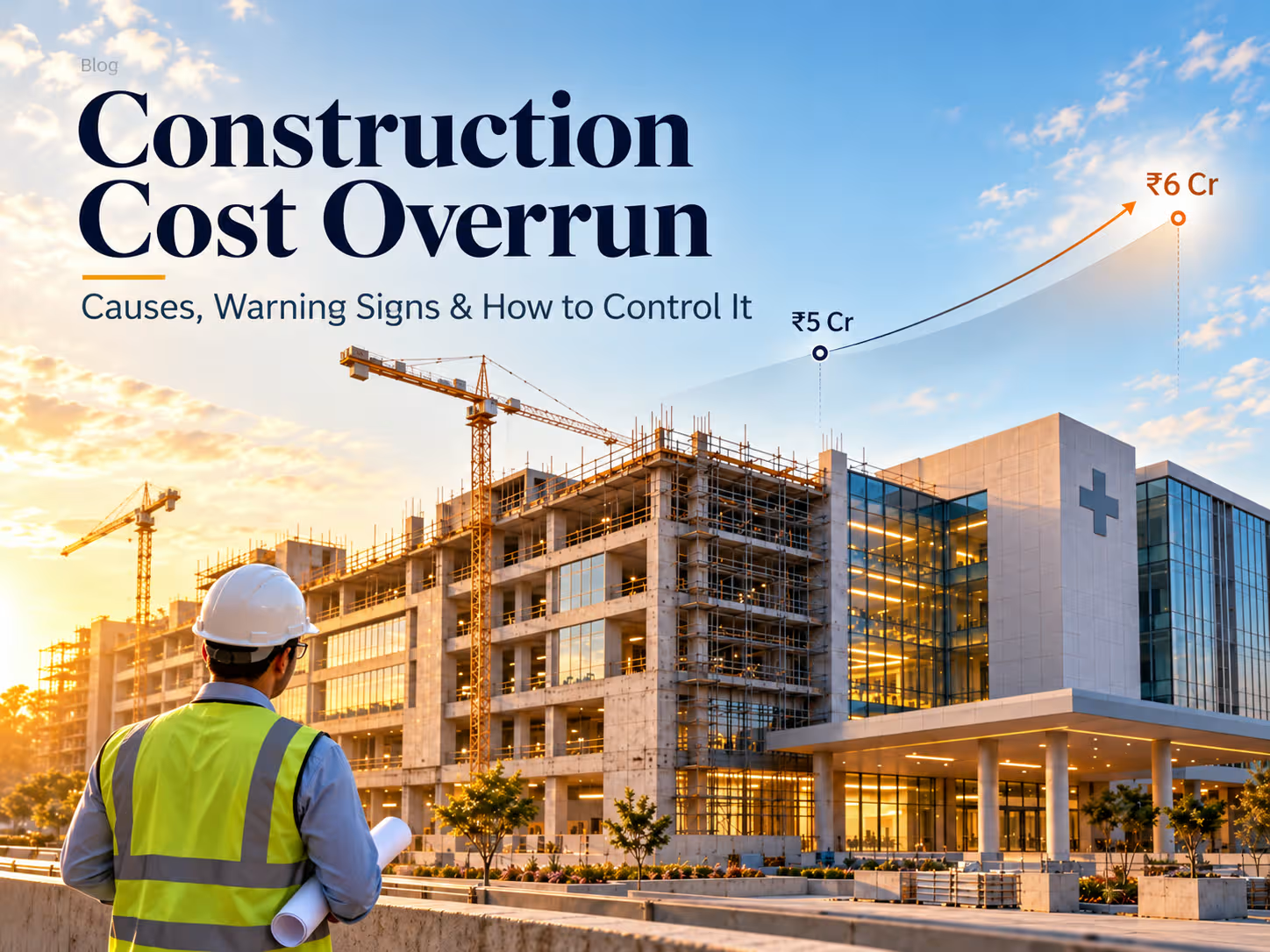
Construction Cost Overrun: Causes, Warning Signs & Control

Renewing a Fire NOC in India is rarely a routine paperwork exercise.
For most institutional, commercial, and public buildings, renewal failures do not stem from missing forms or expired certificates. They arise from how the building has evolved in use, capacity, and layout since the original approval.
As we move into 2026, fire departments across states are tightening inspections, digitising records, and shifting focus from approved drawings to on-ground fire safety performance.
This guide focuses only on Fire NOC renewal realities, why compliant-looking buildings still fail inspections, where risks actually emerge, and how renewal should be approached to avoid last-minute retrofits, penalties, or operational disruption.
Who Should Read This Fire NOC Renewal Guide (2026)
This guide is specifically relevant if you operate, manage, or are responsible for compliance in:
If your building is already operational, this guide will be far more relevant than generic Fire NOC approval explainers, as it focuses on renewal-stage risks and inspection realities.
Why Fire NOC Renewal Matters Beyond Compliance
Fire NOC renewal directly determines whether a building can legally continue operations.
A delayed, conditional, or rejected renewal can lead to:
In regulated sectors such as healthcare and education, Fire NOC renewal delays are among the most common triggers for operational stoppages during annual licensing, accreditation, and inspection cycles.
Fire NOC renewal is not just a safety requirement, it is a business, continuity, and governance risk.
What Fire NOC Renewal Means in Practice
Fire NOC renewal verifies that a live, occupied building continues to meet fire and life safety norms after years of use, modification, and operational wear.
Unlike initial approvals, renewal inspections focus on how the building actually functions today real occupancy, maintained systems, and current usage not just sanctioned drawings.
In effect, Fire NOC renewal is a check on operational reality, not a paperwork extension.
Why Fire NOC Renewals Are Stricter in 2026
Renewal scrutiny has increased due to:
Inspections now routinely include timestamped photos, video system tests, and digital inspection records, making renewals function like mini re-approvals, not clerical renewals.
Who Governs Fire NOC Renewal and Why Delays Cascade
Fire NOC renewal is enforced by the state fire department, but its outcome directly affects:
This is why a delayed or rejected renewal often triggers multi-department compliance risks, even when other licenses appear valid.
Which Buildings Require Fire NOC Renewal
Fire NOC renewal applies to high-risk and public occupancy buildings, including healthcare, education, commercial, assembly, hospitality, and industrial facilities.
Building-wise applicability and state-specific rules are detailed in our Fire NOC in India guide.
Fire NOC Renewal Validity: 2026 Reality
While standard validity periods exist, inspection-observed deficiencies increasingly lead to shorter renewal durations.
Validity is now used as a risk-control mechanism, not a guaranteed entitlement.
Indicative validity timelines and state-wise variations are covered in our Fire NOC guide.
Fire NOC renewal follows a formal sequence, but approval outcomes are decided on site, not on portals.
Understanding what authorities actually assess at each stage is critical to avoiding rejection or forced shutdowns.

1) Application Submission (Administrative Trigger)
Renewal applications are filed through state-specific online portals or offline systems, referencing the previous Fire NOC and declared building details.
At this stage:
Filing does not initiate approval, it only triggers scrutiny.
2) Document Scrutiny (Design vs Reality Check)
Authorities cross-verify submitted records against approved data, focusing on consistency, not completeness.
They typically compare:
Discrepancies at this stage often lead to stricter physical inspections, even if documents are technically complete.
3) Physical Inspection (Critical Approval Stage)
The physical inspection is where most Fire NOC renewals fail.
Inspectors assess whether the building, as it operates today, still meets fire and life safety assumptions.
Key checks include:
This stage determines renewal success or failure.
Most Commonly Missed During Renewal Inspections
These issues are frequently treated as high-risk non-compliances, not minor deviations.
4️) Compliance Outcome (Approval, Conditions, or Rejection)
Based on inspection findings, authorities issue one of three outcomes:
Conditional approvals are increasingly used as risk-management tools, with follow-up inspections common.
During Fire NOC renewal, documents are not reviewed in isolation.
They are cross-checked against on-ground conditions to identify operational drift, capacity changes, and system degradation since the original approval.
Inspectors use documentation to answer one core question:
Does the building still operate within its approved fire safety assumptions?
Key Documents Reviewed During Fire NOC Renewal

Most Fire NOC renewal delays and rejections do not originate during construction they emerge after buildings become operational, when usage, occupancy, and maintenance drift away from approved assumptions.
Typical Fire NOC Renewal Timeline (Ground Reality)
Fire NOC renewal and fresh Fire NOC approvals follow very different evaluation logics, even though they are often treated as similar compliance steps.
Understanding this distinction is critical, because renewal inspections assess operational truth, while fresh approvals evaluate design intent.
Fire NOC Renewal vs Fresh Fire NOC: Practical Comparison
Download the Fire NOC Renewal Checklist Now
Fire NOC renewal is not a routine approval.
It is a real-world test of how well a building has been planned, operated, and governed after occupation.
Most renewal failures occur because fire safety, capacity, and compliance are treated as post-construction tasks, instead of being embedded into design and execution from the start.
BuiltX delivers end-to-end, approval-aware construction for hospitals, educational institutions, hostels, and social-impact projects—integrating planning, compliance, fire safety, and execution into a single, coordinated process.
If you are planning a new project or upgrading an existing facility, working with BuiltX early helps avoid approval delays, redesigns, and operational risk.
Contact BuiltX for end-to-end, impact-driven construction that clears approvals and performs safely in operation.
Q1. Is Fire NOC renewal mandatory every year?
Yes. For hospitals, hostels, assembly buildings, and other high-risk occupancies, Fire NOC renewal is usually annual. Other buildings may have longer validity depending on state rules and inspection outcomes.
Q2. Can Fire NOC renewal be rejected even if fire systems are installed?
Yes. Renewals are rejected when installed systems do not match actual occupancy, layout changes, or maintenance records, even if equipment is physically present.
Q3. How long does Fire NOC renewal take in India?
In practice, Fire NOC renewal takes 3–12 weeks, depending on inspection scheduling, rectification requirements, and re-inspection cycles.
Q4. Can Fire NOC renewal be applied online without inspection?
No. Online application only initiates the process. Physical inspection is mandatory, and approval is based on on-ground verification.
What happens if Fire NOC expires during operation?
Expired Fire NOC can lead to shutdown notices, blocked license renewals, insurance risks, and potential personal liability for responsible authorities.