Sustainability
September 8, 2026
Top 15 Green Building Materials in India: Costs & Uses (2026)

Planning a building expansion whether vertical or horizontal is one of the most irreversible decisions in construction.
If you’re considering:
you are already at a high-risk decision point.
Contrary to popular belief, the biggest risk in building expansion is not construction cost, approvals, or timelines.
The real risk lies in choosing the wrong expansion strategy early vertical versus horizontal and later discovering that your building cannot grow the way you planned.
Many organisations realise this too late:
At that stage, even having land, budget, or permissions does not guarantee successful expansion the original layout becomes the constraint.
This article examines vertical vs horizontal expansion in construction through real planning failures, explains where each approach commonly breaks down, and outlines the critical factors you must evaluate before locking in an expansion strategy.
Read about 456:2000 RCC Design Code Explained
Vertical expansion in construction is often considered the safest long-term option, especially on land-constrained or urban sites. Many projects assume that additional floors can always be added later if zoning regulations permit it.
In reality, a large number of buildings cannot be vertically expanded, even when height permissions exist. The limitation is rarely regulatory—it is almost always structural, service-related, or compliance-driven.
One of the most common Phase-1 decisions is to design the building structure only for immediate requirements, primarily to reduce upfront construction cost.
This typically means:
When vertical expansion is attempted later:
At this stage, adding floors often requires:
What was assumed to be a “future option” becomes financially and operationally unviable.
Even when the structural system can technically support additional floors, building services frequently become the first point of failure in vertical expansion planning.
Common service-related constraints include:
Vertical expansion requires proportional scaling of:
If service shafts are not sized or aligned for future expansion, new floors may exist structurally—but cannot be serviced efficiently or compliantly.
Vertical expansion must comply with fire and life-safety regulations, which become progressively stricter as building height increases.
Key constraints include:
Many buildings meet fire compliance for their current height, but fail to meet requirements once additional floors are proposed.
Retrofitting fire stairs, exit corridors, or refuge areas in an operational building often requires:
In many cases, this alone makes vertical expansion practically impossible, regardless of structural feasibility.
Hospital Construction Requirements in 2026
Horizontal expansion in construction is often considered the most flexible growth strategy, particularly for campuses, institutional projects, hospitals, and educational facilities. Large land parcels create the assumption that future expansion will always be possible.
In practice, many projects with ample land still fail to expand effectively. The limitation is rarely land availability—it is poor site zoning, utility planning, and long-term circulation strategy.
One of the most common horizontal expansion mistakes occurs in the initial phase of development.
During Phase-1, it is typical to place:
in locations that later become the only logical zones for expansion.
Over time, the site becomes fully occupied by:
The result is a familiar problem:
In many horizontally planned projects, utilities are routed only for current needs, without a long-term master plan.
This leads to:
When expansion is later attempted, it may require:
For hospitals, schools, and active campuses, such disruptions are often unacceptable—making expansion theoretically possible, but practically unviable.
As horizontal expansion progresses, campuses frequently suffer from scale-related inefficiencies.
Common issues include:
What operates efficiently at a small or medium scale can become:
Over time, these inefficiencies increase the total cost of ownership, even if construction costs were initially controlled.
How to estimate construction timeline for your construction project in 2026
When comparing vertical and horizontal expansion in construction, most failures do not happen because one approach is inherently wrong. They happen because the chosen expansion strategy is not validated against long-term feasibilitystructural, operational, and regulatory.
The table below highlights where projects most commonly break down.
In construction and campus planning, most expansion failures are not caused by lack of land, budget, or approvals.
They are caused by freezing site and layout decisions too early in the project lifecycle.
This typically happens when:
Once construction commences, layout flexibility reduces significantly.
At this stage:
However, the built configuration itself becomes the constraint.
Structural systems, service corridors, circulation cores, and site zoning are already fixed. Any modification after this point involves disproportionate cost, operational disruption, or technical compromise.
This is why many buildings are theoretically expandable—but practically constrained when expansion is actually required.
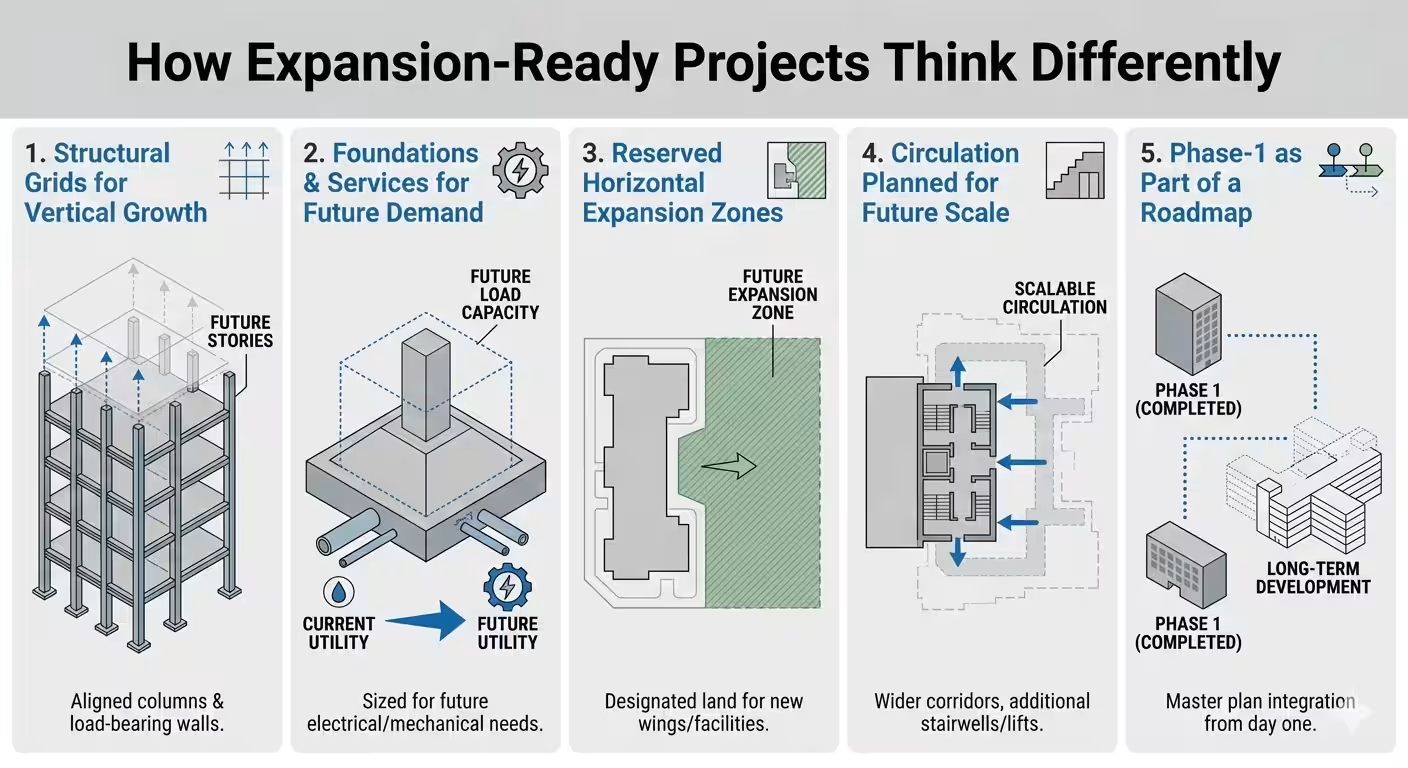
Before deciding between vertical or horizontal expansion in construction, it is important to evaluate whether your existing building and site can realistically support future growth.
Ask these key questions:
If clear answers to these questions are not available today, the expansion risk already exists.
Addressing these points early in the expansion planning stage helps avoid structural limitations, service failures, and costly operational disruptions later.
1. Which is better for building expansion: vertical or horizontal?
There is no one-size-fits-all answer. The right choice depends on site constraints, structural capacity, service scalability, fire compliance, and long-term growth plans. Each option carries different risks if not planned early.
2. Can an existing building be expanded vertically later?
Vertical expansion is possible only if the original structure, foundations, services, and fire systems were designed for future floors. Many existing buildings cannot add floors safely without major strengthening.
3. Why does horizontal expansion fail even when land is available?
Horizontal expansion often fails when future building zones are consumed by parking, landscaping, utilities, or access roads during Phase-1 planning, leaving no usable space for growth later.
4. When should expansion planning be done in a construction project?
Expansion planning should be done at the initial master-planning or Phase-1 design stage. Once construction begins, layout flexibility reduces significantly and future expansion becomes costly or impractical.
5. How do I know if my site is ready for future expansion?
A site is expansion-ready only if its structure, services, circulation, and zoning are validated for future growth. An expansion-feasibility or layout-risk review can identify limitations before decisions are locked.
Choosing between vertical or horizontal expansion in construction is not a design preference, it is a long-term strategic decision that directly affects cost, operations, and future growth potential.
Once a layout is finalised and construction begins, the ability to change course reduces sharply. At that stage, even if land, approvals, and budget are available, the building itself can become the limiting factor.
Before committing to a vertical or horizontal expansion strategy, it is essential to validate:
A brief expansion-feasibility review at the planning stage can prevent years of limitation, rework, and avoidable cost later.
If you are planning to expand an existing building and need clarity on whether vertical or horizontal growth is feasible for your site, BuiltX offers expansion-feasibility and layout-risk reviews before irreversible decisions are made.
This evaluation helps project owners, trustees, and institutions make informed expansion decisions before layouts are frozen and flexibility is lost.
Book your free call now to consult regarding building expansion