Construction delays are more common than most project owners expect. Global studies show that large construction projects often run 20% longer than planned and exceed original budgets significantly, with only about half of projects finishing on time.
This makes accurate construction timeline estimation critical — not just for cost control, but for approvals, funding, and operational planning.
This guide is designed for hospital promoters, educational and CSR project owners, NGOs, and institutional developers, using an India-first approach supported by global benchmarks.
Inside this guide, you’ll learn:
What actually drives construction timelines
Typical duration ranges by project type and scale
A practical 5-step method to estimate timelines using quantities and productivity
India-specific approval and pre-construction timelines
How to add realistic buffers based on common delay patterns
A worked example for a mid-size institutional project
How BuiltX plans timelines for hospitals, schools, and CSR infrastructure
Note: All timelines shared here are indicative benchmarks, not guarantees. Final schedules should always be validated with your project team, site conditions, and local approvals.
What Actually Drives a Construction Timeline?
When owners ask, “How long will my project take?”, the real question is: Given the project constraints, what is a realistic construction timeline if execution is planned properly?
The actual timeline is driven by a combination of the following factors:
Built-up area & height: Larger floor areas and taller buildings naturally take longer due to increased structural work, services, and finishing scope. Basement construction significantly extends timelines because of excavation, waterproofing, and retaining structures.
Project type & complexity: A simple warehouse can be completed far faster than a hospital or institutional building of the same size. Facilities like hospitals, laboratories, and data centres involve dense MEP services, equipment coordination, and extended testing and commissioning phases.
Approval & pre-construction timelines: Before construction begins, projects must clear building plan sanctions, fire approvals, and other statutory permissions. In India, approvals in major cities typically take 45–100 days, depending on state systems and local conditions — and this period must be included in any realistic timeline.
Procurement & supply chain: While basic materials are usually available, specialized items such as HVAC systems, lifts, façades, and medical or lab equipment have longer lead times. Delayed procurement of these packages is a common cause of schedule overruns.
Labour productivity & site logistics: Construction duration depends on workforce strength, skill levels, and achievable daily output. Congested urban sites, limited access, and restricted crane usage often reduce on-site productivity compared to planning assumptions.
Contract strategy & project management: Turnkey/EPC contracts, clear scope ownership, structured scheduling, and professional project management significantly improve timeline predictability compared to fragmented multi-package execution.
External risk factors: Monsoons, holidays, funding delays, design changes, land or legal issues, and slow decision-making can all disrupt even well-planned schedules.
These are high-level ranges seen in industry literature and practice. Use them only as a starting point – complexity and approvals can easily push projects to the higher side.
For Indian institutional projects (hospitals, schools, college blocks), a very rough rule of thumb used by many planners is:
S. No.
Built-up Area
Type (Typical)
Concept-to-Commissioning (including approvals)
1
20,000–40,000 sq ft
Small school block, clinic, hostel
12–16 months
2
50,000–80,000 sq ft
50–100 bed hospital, mid-size academic block
18–24 months
3
100,000–200,000 sq ft
Multi-block campus, large hospital or office park
24–36 months
These ranges assume reasonable approvals, funding continuity, and coordinated design. Highly specialised medical or industrial facilities can exceed these ranges.
The 5-Step Method to Estimate Construction Timeline
Instead of asking “How many months will this take?”, treat timeline estimation as a simple calculation:
Duration = Quantity ÷ (Productivity × Effective Workforce)…adjusted for sequencing, dependencies, and buffers.
This 5-step method works for most building projects.
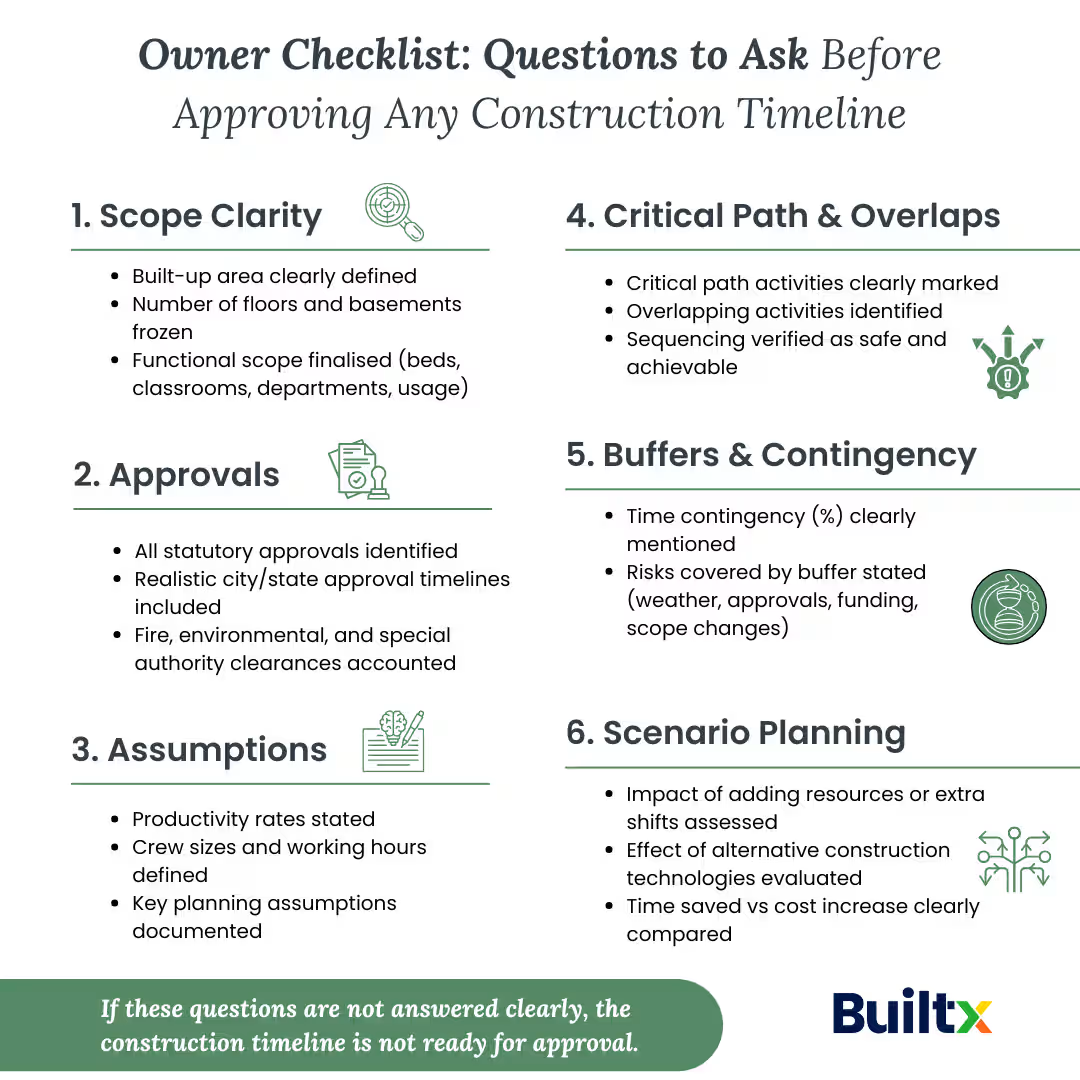
Step 1: Define Scope & Constraints Clearly
Before estimating time, clearly define:
Built-up area, number of floors, and basements
Project type (hospital, school, factory, office, residential)
Structural system (RCC, steel, PEB, precast)
Location and site constraints (urban vs. greenfield, access, working hours)
Design maturity (concept vs. GFC drawings)
Step 2: Break the Project Into Phases
Estimate timelines phase by phase, then combine them into a master schedule.
Typical phases include:
Pre-construction & approvals
Enabling works and foundations
Superstructure
Building envelope and MEP rough-ins
Internal finishes and services
Testing, commissioning, and handover
This approach makes both estimation and tracking far more reliable.
Step 3: Use Quantities & Productivity (Not Gut Feel)
Avoid blanket assumptions like “brickwork will take three months.” Instead, use:
Time = Total Quantity ÷ Daily Output
For example, if total brickwork is 5,000 m² and your effective site output is ~100 m²/day, the activity takes ~50 working days, which may translate to 3–4 calendar months once sequencing and weather are considered.
Apply the same logic to excavation, RCC, formwork, plastering, and finishes. What matters is not the exact norm, but that the contractor shows clear logic behind quantities, crew size, and productivity.
No matter how efficient the contractor, construction cannot begin without:
Sanctioned drawings
Building permit
Fire NOC and applicable environmental clearances
What the data says Under India’s Ease of Doing Business reforms, approval timelines have reduced significantly in many cities. Official figures show that construction permit timelines in major metros now typically range between 90–100 days, and several states have implemented single-window approval systems targeting approvals within 30–45 days.
What happens on the ground In real projects, owners and designers still report:
1.5–3+ months for standard building permit cycles in well-functioning urban local bodies (when documentation is complete)
Longer timelines where land titles, environmental sensitivity, heritage zones, height restrictions, or special authority clearances are involved
This makes approvals a critical part of the construction timeline, not a parallel afterthought.
Practical Owner Checklist for Approvals
To prevent pre-construction delays:
Initiate concept design and regulatory discussions early
Ask your design team to map all required approvals, including:
Building plan sanction
Fire NOC
Environmental or pollution control clearances (if applicable)
Special authority clearances (airport, highway, railway, defence zones)
Utility connections (water, sewer, power)
Also ensure:
A separate approvals timeline is built into the project schedule
Clear responsibility is assigned for documentation and follow-ups (architect vs. owner)
How Long Construction Really Takes: An Owner’s View
Here’s a simplified owner-friendly matrix you can use to sanity-check proposals. These assume design is complete and approvals are obtained before main construction.
These are generic global/India-blended ranges, not commitments. Always localise.
S. No.
Project Type & Size
Typical Construction Duration (Post-approval)
1
1,000–1,500 sq ft G+1 home
6–10 months (Walls and Dreams)
2
2,000–3,000 sq ft custom home
10–18 months (coconstruct.com)
3
10,000 sq ft simple commercial / office
4–6 months (Autodesk)
4
50,000 sq ft mid-complex commercial / institutional
8–12+ months (Autodesk)
5
50–100 bed hospital (India, NABH-oriented)
14–20 months for construction, plus commissioning
6
Multi-block campus / large hospital (100k+ sq ft)
20–30+ months
When someone claims “50,000 sq ft hospital in 8 months, end-to-end”, this matrix should prompt you to ask:
Are approvals excluded?
Is the design fully frozen?
Are we assuming double shifts / fast-track construction / prefabrication?
Indicative pre-construction window: 4–7 months (with overlaps and proactive coordination)
Step 2 – Main construction (high-level phasing)
Enabling & foundations – 2–3 months
Site setup, excavation, foundations, plinth, underground tanks.
Superstructure – 5–7 months
Assume a 7–10 day slab cycle per typical RCC frame, adjusted based on crane/formwork strategy and productivity norms.
Use productivity norms (m³ of RCC per crew per day, m² of formwork per carpenter per day) from IS/CPWD references to check whether crew sizes match the claimed cycle.
Brickwork & plastering – 3–5 months (overlapping)
Start brickwork on lower floors while structure rises above.
Duration depends on wall areas, door/window % and number of mason teams.
In 2026, estimating a construction timeline is not about guessing months, it’s about planning execution realistically.
As this guide shows, accurate construction timelines are built by breaking projects into phases, grounding durations in quantities and productivity, accounting for India-specific approval timelines, and adding buffers for real-world risks. When any of these are ignored, delays are almost inevitable.
For complex projects like hospitals, educational campuses, and CSR infrastructure, the difference between an optimistic schedule and a workable one lies in early clarity, transparent assumptions, and disciplined planning.
This is the approach BuiltX follows when planning institutional and healthcare projects, treating timelines as an outcome of design, approvals, execution strategy, and risk management, not as a sales promise. If you’re looking for a construction partner that prioritises predictability, transparency, and on-ground execution, BuiltX can help you plan and deliver with confidence.
Use the frameworks in this guide to challenge unrealistic schedules, ask better questions, and commit to timelines that can actually be delivered.