Sustainability
September 8, 2026
Top 15 Green Building Materials in India: Costs & Uses (2026)

Hospital construction cost in India in 2026 depends on much more than the number of beds. Location, built-up area, hospital type, ICU and operating theatre requirements, MEP systems, medical equipment, and project specifications can significantly change the final budget.
For preliminary planning, hospital construction is often compared using two benchmarks: cost per square foot and cost per bed. Current industry estimates indicate that hospital construction can broadly range from around ₹3,500 to ₹8,000 per sq ft, depending on the scope of civil works, MEP services, HVAC, medical gas infrastructure, fire safety systems, and interior specifications.
However, construction cost should not be confused with total hospital project cost. Land, major medical equipment, furniture and fixtures, IT systems, professional fees, financing, and pre-opening expenses may be calculated separately.
This guide explains hospital construction costs in India in 2026, including cost per sq ft, cost per bed, major cost components, project size, MEP requirements, approvals, and the factors that have the greatest impact on hospital budgets.
Hospital Floor Plan Design Guide (2025): Codes, Layouts & Best Practices
Hospital construction costs can vary widely even between projects with the same number of beds. The most important cost drivers include:
1. Built-Up Area: A larger built-up area per bed increases civil, architectural, HVAC, electrical, plumbing, and maintenance requirements.
2. Hospital Type: A secondary-care hospital usually requires less specialised infrastructure than a tertiary or super-specialty hospital.
3. ICU and Critical-Care Capacity: ICUs require higher electrical redundancy, medical gas systems, monitoring infrastructure, HVAC control, and specialised finishes.
4. Operating Theatres: The number and type of operating theatres affect HVAC design, filtration, electrical systems, medical gases, sterile circulation, and equipment requirements.
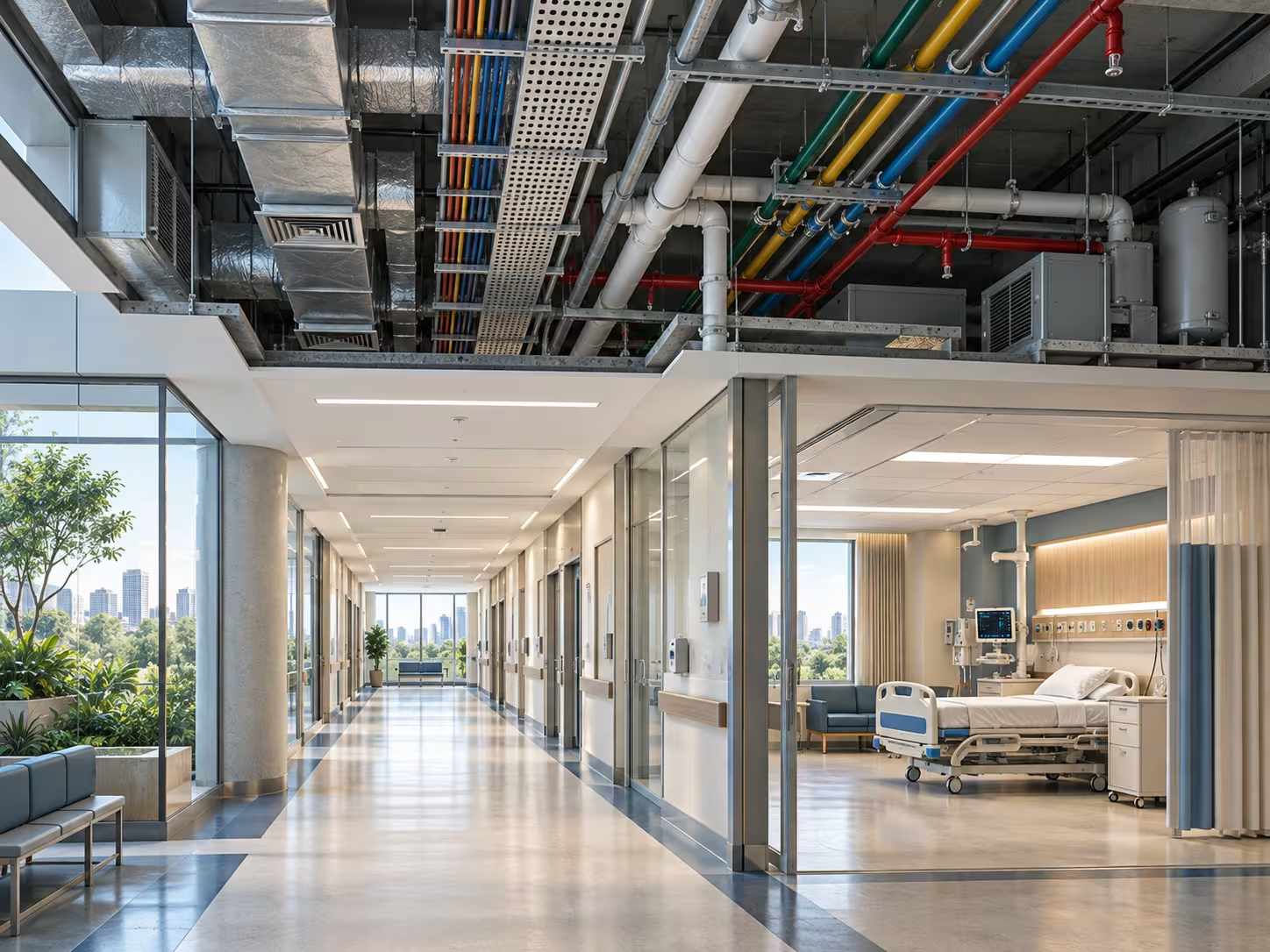
5. MEP Complexity: Healthcare buildings require significantly more intensive MEP systems than conventional commercial buildings, including HVAC, medical gases, backup power, fire protection, plumbing, and building management systems.
6. Medical Equipment: CT, MRI, cath labs, advanced diagnostic equipment, modular OTs, and high-acuity ICU equipment can substantially increase overall hospital project CAPEX.
7. Location and Site Conditions: Labour costs, material transportation, soil conditions, utility availability, climate, and local regulations can all affect construction costs.
8. Project Specification: Higher-grade finishes, sustainability targets, energy-efficient systems, infection-control requirements, and advanced digital infrastructure can increase initial capital expenditure while potentially reducing long-term operating costs.
Learn about hospital planning, here is a BuiltX guide to it
Here, GST, FF & E (Furniture, Fixtures, and Equipment), Land rates are excluded.
Source: JLL and BuiltX internal knowledge
In the JLL report, information is provided for 100 beds (as per 2023) and according from CBRE reports (2023 there was increase in prices by 10% from 2020-2022. So, to calculate the rates for 100 beds (2025), 10% increament is considered.
Explore how green building certifications can reduce hospital operational costs
(a) HVAC & Airflow: Negative Pressure and NABH-Compliant Safety Systems
(b) Medical Gas Systems & Alarm Networks: Compliance-Critical Details
(c) Sustainable Roofs & Water Systems: Cost-Effective Green Upgrades
(d) Low-VOC Finishes & Indoor Air Quality: Design for Health Compliance
Low-Cost Construction Techniques & Materials in India to Reduce Construction Cost (2026 Guide)
(a) Imaging Suite – CT & MRI
*Converted at ₹84 ≈ US $1; assumes 12 % import duty + GST.
Tip: Vendor-finance bundles wrap service + tube coverage, keeping your Year-1 cash cost 30 – 40 % lower than outright capex—a lifesaver for faith-based hospitals relying on donations.
(b) Cath Lab Setup Costs: From Refurbished Units to PPP Wings
(c) ICU & Telemedicine: Devices That Define NABH-Ready Care
(d) Path Lab & CSSD: Smart Costing for Diagnostics & Sterility
(e) Hospital Equipment Financing & Tax Benefits: Smart Capital Moves
These are the cheques you cut long before the first patient walks in. Skimp here and your shiny new wards may sit idle for months.
(Budget ~10 – 15 % of total hospital construction cost just for these “invisible” line-items)
BuiltX Tip: Use pre-audit tools + embed clean power strips during foundation pour to save 50 % on rework.
Pro tip: If you are a charity hospital, flag your Section 8 or Trust deed during CEA filing—several states give fee rebates of up to 50 %. A seasoned construction company for nonprofits—like BuiltX—knows which annexures unlock the discount.
Click to know the Construction Cost of your Infrastructure Project
All fees exclude 18 % GST. Consultant charges may vary by bed count and service mix.
State-wise fees vary: Delhi and Karnataka are among the highest; Rajasthan among the lowest.
Add NABH fees (see Section 3) once 3–6 months of clinical data are ready.
How to Renew Fire NOC in India: Process, Cost & Timeline
1. What is the hospital construction cost in India in 2026?
Hospital construction cost in India varies depending on hospital type, location, built-up area, MEP requirements, clinical services, and project specifications. For preliminary planning, current market benchmarks broadly indicate approximately ₹3,500–₹8,000 per sq ft for hospital construction, depending on the scope included.
2. What is the hospital construction cost per square foot in India?
Hospital construction cost can broadly range from approximately ₹3,500 to ₹8,000 per sq ft in 2026. Advanced tertiary-care or super-specialty hospitals may exceed this range because of more complex HVAC, medical gases, critical power, operating theatres, ICUs, and specialised interiors.
3. What is the hospital construction cost per bed in India?
Cost per bed is commonly used as an early-stage hospital CAPEX benchmark, but there is no single standard rate applicable to every hospital. The cost depends on built-up area per bed, hospital type, ICU and OT capacity, MEP complexity, medical equipment, and location.
4. How much does a 50-bed hospital cost in India?
The cost of a 50-bed hospital can vary significantly depending on built-up area, specialty mix, equipment, location, and engineering requirements. A reliable estimate should therefore be prepared using the expected built-up area, construction rate, MEP scope, medical equipment, FF&E, professional costs, and contingency.
5. How much does a 100-bed hospital cost in India?
A 100-bed hospital cannot be accurately priced using bed count alone. A secondary-care 100-bed hospital and a tertiary-care 100-bed hospital may require very different areas, equipment, operating theatres, ICU capacity, and MEP infrastructure.
6. Does hospital construction cost include medical equipment?
Not always. Many construction cost benchmarks include civil, architectural, and core MEP infrastructure but exclude major medical equipment, land, FF&E, IT systems, financing, pre-opening expenses, and working capital. The inclusions and exclusions should always be checked before comparing hospital cost estimates.
Ready to model your own numbers? Contact BuiltX SDC’s hospital construction desk for a free 30-minute feasibility call—and fast-track your facility from concept to certificate.
Learn How BuiltX Core Values Align with Sustainable Design Practices