Sustainability
September 8, 2026
Top 15 Green Building Materials in India: Costs & Uses (2026)
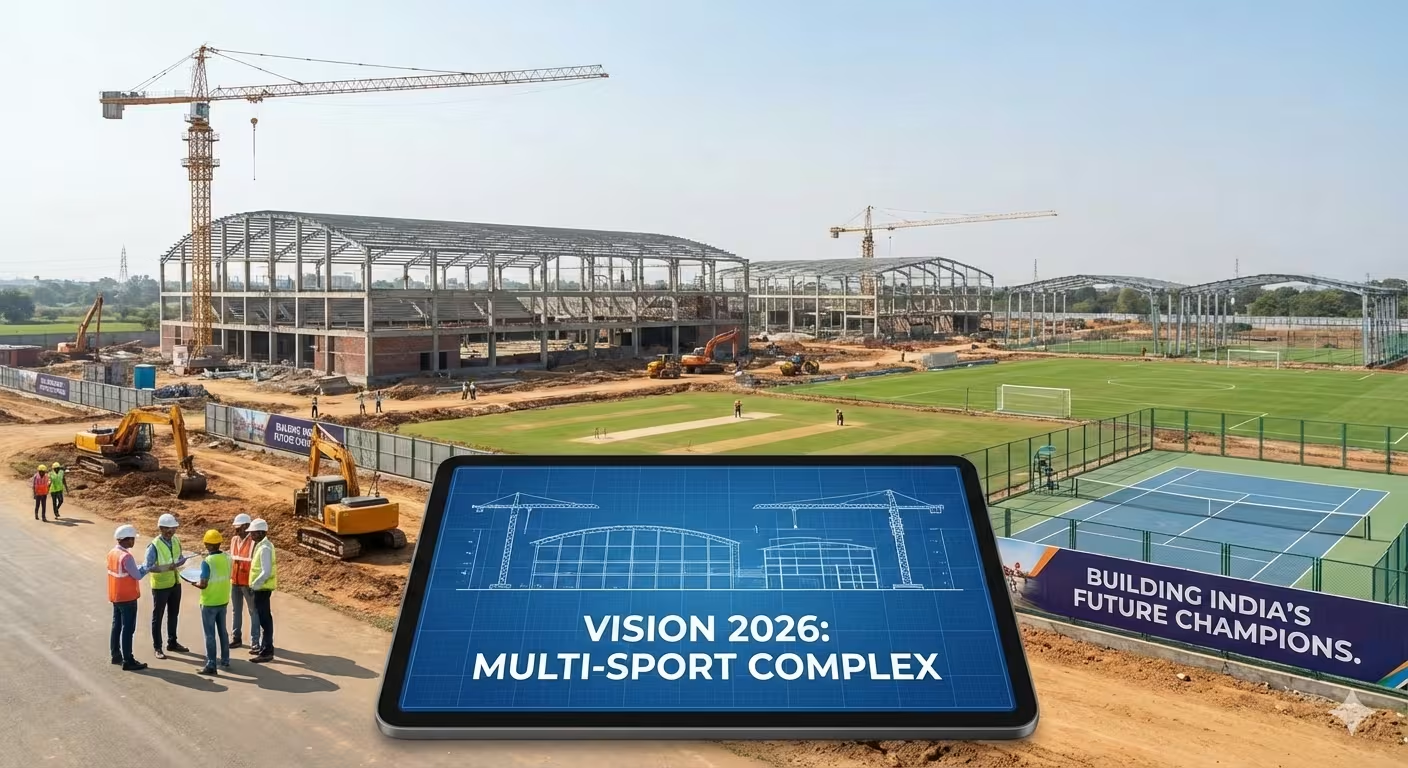
The demand for multi-sport complexes in India is rising as governments, universities, NGOs, and private operators invest more in sports infrastructure. These facilities support multiple games in one campus and are used for training, competitions, and community sports.
A key driver is the Khelo India sports infrastructure scheme, which supports facilities such as synthetic athletics tracks, football and hockey turfs, indoor sports halls, and swimming pools, with combined project funding support of up to ₹50 crore, depending on scope.
States are also building district-level sports complexes. For example, Tamil Nadu is developing futsal and box-cricket turfs across districts, with typical project costs of around ₹60 lakh per facility (The Times of India).
As a result, demand for sports complex construction in India now comes from state sports departments, municipal bodies, educational institutions, CSR projects, and private academies. The challenge today is not whether to build, but how to plan and execute a multi-sport complex that is affordable, compliant, and sustainable.
Youth Sports Facility Design Guide 2026
Before you start designing a multi-sport complex, three early decisions will shape your cost, layout, and long-term success.
Most sports complexes in India fall into one of these categories:
Each group has different expectations around accessibility, fees, operating hours, and level of play from grassroots participation to competitive training.
The level of play directly affects hall size, roof height, and construction cost.
As per SAI model design guidelines, a typical multipurpose indoor sports hall is 40 m × 20 m with a clear height of around 9 m, allowing:
Recommended clear heights vary by sport:
If your goal is district-level training, you can often reduce roof height and façade complexity, saving significant construction cost compared to national or TV-ready arenas.
Your business model should be clear from day one:
In many Indian cities, box-cricket and turf facilities charge ₹700–₹2,000 per hour, depending on location and time slot (The Times of India).
Finalising this early helps decide parking size, food courts, spectator seating, commercial areas, and finishing levels, all of which directly affect project cost.
See these 10 hospital design requirements to avoid mistakes
One of the most common questions when planning a multi-sport complex in India is simple: How much land do we actually need?
The answer depends on the mix of facilities, but standard sports dimensions give a reliable starting point.
Using Indian and international sports standards:
When these elements are combined, a basic district-level multi-sport complex—with:
typically requires about 5–10 acres of well-shaped land.
Larger city-level sports complexes, which include multiple grounds, hostels, staff housing, or commercial areas, often need 15–20 acres or more. For example, the Naranpura Sports Complex in Ahmedabad spans around 21 acres.
Practical tip: Before finalising land, overlay actual sports field dimensions and run-off zones on a satellite image. Many plots that look large on paper become tight once you add a 400 m track, access roads, and parking.
How to design Emergency, ICU, OPD layout in Hospital in 2026
When you build a multi-sport complex in India, you are not just creating courts and fields you are constructing large public buildings that host players, spectators, and staff. That means safety, structure, and approvals must be planned carefully from the start.
All sports complexes must comply with the National Building Code of India (NBC 2016). Stadiums and indoor arenas are classified as Assembly Buildings, which means the design must account for:
In addition, local building bye-laws govern floor area limits (FSI), setbacks, height restrictions, and parking requirements. These rules vary by city and state, so early coordination with local authorities is essential.
Sports buildings often have large column-free spans, especially indoor halls and spectator stands. Structural design is therefore carried out as per Indian Standards, including:
Using current seismic standards is critical for roof systems and steel structures commonly used in sports complexes.
Beyond building codes, each sport has its own requirements for playing area size, run-off zones, clear heights, and finishes.
In India, these are primarily guided by:
Khelo India guidelines explicitly require project designs to follow SAI specifications for these facilities.
Depending on the project size and location, approvals for a sports complex in India usually include:
How to construct an affordable hospital in 2026
The cost of building a multi-sport complex in India can vary widely. Location, soil conditions, quality of finishes, and the level of play all influence the final budget. The figures below are benchmarks, not quotations useful for planning and DPR preparation.
Under the Khelo India sports infrastructure guidelines, the Government of India has defined maximum admissible grants for common sports facilities (central share only):
When combined, these modules can take the total reference project value to around ₹50 crore. Costs beyond this are typically borne by the state or project owner. These limits are widely used as DPR planning benchmarks even for non-Khelo projects.
As per SAI model designs, a standard four-court multipurpose indoor hall includes:
This works out to roughly:
This range is realistic for training-level indoor halls. Competition-ready halls with full AC, seating, and premium façades will cost more.
Some common surface cost ranges seen across India:
For a 5,000–10,000 sq ft turf, this typically translates to:
These figures align with publicly reported district-level turf and futsal projects in states like Tamil Nadu and Uttar Pradesh.
Publicly reported examples help place projects in context:
In broad terms (excluding land cost):
These ranges are meant to guide early decision-making, not replace a detailed estimate. Every serious sports infrastructure project should be supported by a formal DPR and quantity-surveyed cost plan.
How to do hospital expansion in 2026
The timeline for building a multi-sport complex in India depends largely on land readiness, approvals, and funding flow. While every project is different, Indian examples give a clear sense of what to expect.
Smaller facilities such as futsal or box-cricket turfs have been completed within 1–6 months once civil work begins. At the other end, larger stadium projects — like the Salem cricket stadium in Tamil Nadu — took several years from land allocation to opening.
For most owners, a realistic end-to-end timeline looks like this:
This stage defines the project:
Projects aligned with Khelo India also prepare the required applications and annexures during this phase.
Once the concept is clear:
Approval timelines vary widely by city, making early coordination critical.
This phase includes:
Clear scopes at this stage help avoid delays during construction.
Before opening:
Under Khelo India, funding is released in construction-linked milestones (30%, 60%, 90%, 100%), a discipline that works well even for privately funded projects.
How to build low cost-sustainable sports infrastructure
A well-designed multi-sport complex should feel easy to navigate, safe during peak events, and comfortable for both athletes and spectators. Good layout planning is what separates a functional campus from a confusing one.
The simplest way to plan a sports complex layout is to divide the campus into clear zones:
As per SAI model design guidelines, good layouts ensure:
This separation improves safety, crowd control, and day-to-day operations.
A common district-level multi-sport complex in India usually includes:
The key is logical clustering placing related facilities close together while keeping public, athlete, and service movement clearly separated.
This is where experience in large, multi-building campuses matters. The same planning logic used for hospitals, hostels, and educational campuses where thousands of users move through the site daily applies directly to sports campus design. Firms like BuiltX, with experience in such complex institutional layouts, bring that circulation-first thinking into sports infrastructure projects as well.
Which construction contractors will be best for your project in 2026
Building a multi-sport complex in India is not just a construction exercise it is a planning challenge. The long-term success of a sports complex depends on choosing the right mix of facilities, following SAI, Khelo India, NBC, and federation standards, and aligning costs, layouts, and timelines with how the facility will actually be used.
Many sports complexes struggle because of poor early decisions overbuilt facilities, layout mistakes, approval delays, or no clear plan for operations and maintenance. Getting clarity at the DPR and masterplanning stage is what separates successful sports campuses from underused assets.
This is where a specialist sports infrastructure company in India adds real value. With experience delivering complex institutional projects across India, BuiltX Sustainable Design & Construction brings an integrated approach covering planning, design, approvals, and turnkey execution that helps promoters build sports facilities that are compliant, cost-efficient, and sustainable.
If you are a private body, university, NGO, CSR team, or private academy planning a multi-sport complex, engaging an experienced partner like BuiltX early can save time, cost, and future rework.
Because lasting sports infrastructure is built on planning not guesswork.