Construction
August 19, 2026
IS 1893:2025 vs 2016: What Changed and What Is Currently Applicable?
Planning a hospital project rarely begins with construction drawings. The real complexity starts much earlier when promoters must decide how the hospital will grow over time.
One of the most important strategic decisions is whether the hospital should be constructed fully in a single phase or developed in multiple phases as demand grows.
This decision influences far more than construction timelines. It affects:
In many projects, this choice is addressed too late — after design work has already started. By that point, changing the development strategy can lead to redesign, cost escalation, or expansion constraints.
This guide explains phased hospital construction vs single-phase construction, when each approach works best, and how healthcare institutions plan facilities that can grow safely and efficiently over time.
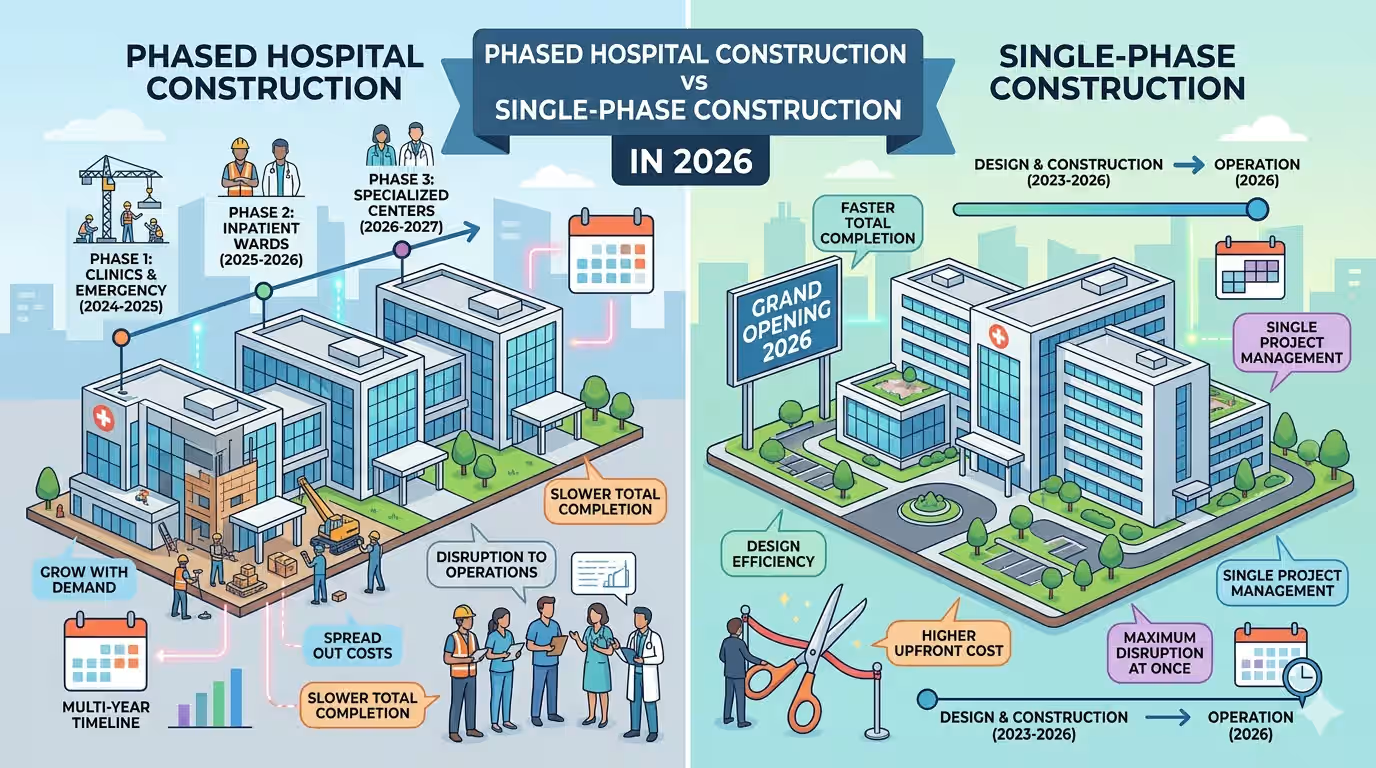
Phased hospital construction is a development strategy where a hospital is built and expanded in planned stages instead of constructing the entire facility at once.
The hospital begins with a core operational facility and expands its capacity as demand increases.
A typical phased development roadmap may look like this:
Each phase is designed so that future expansions can integrate with minimal disruption.
This model is often used by:
Single-phase hospital construction means building the entire hospital facility in one development cycle.
The hospital is fully completed before operations begin.
A single-phase hospital project typically includes:
Construction timelines for such projects usually range between 18–36 months depending on scale and complexity.
This model is common in:
The differences between these approaches become clearer when viewed across planning and operational factors.
Both strategies can work successfully but the right choice depends on funding structure, land availability, and long-term patient demand projections.
Phased development is often preferred when healthcare institutions want to balance investment with real demand growth.
Healthcare infrastructure projects require significant capital.
Hospital construction costs in India typically range from:
₹3,000 – ₹6,000 per sq ft depending on medical infrastructure intensity and equipment requirements.
Building the entire hospital at once can require extremely large upfront investment.
Phased construction allows institutions to:
Many hospitals start with smaller bed capacity and expand gradually as patient volumes increase.
This approach is common in:
Instead of building unused wards initially, phased development allows hospitals to expand when utilization increases.
Phased development requires careful campus planning from the beginning.
Hospitals must reserve space for:
Without this planning, later expansion becomes inefficient or even impossible.
BuiltX Insight: On real hospital projects, expansion challenges rarely arise from structural limitations. More often, problems occur because future service corridors, plant rooms, or vertical shafts were not planned during the first phase.
Hospitals that design their campus master plan early usually expand far more smoothly.
Single-phase development is appropriate when the hospital already knows its long-term scale and service scope.
Large healthcare organizations typically build hospitals fully in one phase because:
This allows hospitals to start with full service capabilities.
Teaching hospitals often require complete infrastructure from the start.
Regulatory frameworks governing medical education require:
These requirements often make phased development impractical.
In cities where land availability is limited, hospitals often choose single-phase construction because future horizontal expansion is not possible.
Building the full hospital upfront ensures the facility can meet long-term demand.
While phased development offers flexibility, it introduces significant planning complexity.
Even when Phase 1 is small, certain infrastructure systems must be designed for future hospital capacity.
These include:
If these systems are undersized initially, later expansion becomes extremely costly.
BuiltX Insight: In practice, phased hospitals often oversize core infrastructure during Phase 1. While this increases early construction cost slightly, it prevents expensive retrofits when later phases are added.
The cost comparison between these strategies is not always straightforward.
Phased construction reduces initial financial pressure, but single-phase construction often achieves better cost efficiency over the entire project lifecycle.
The decision therefore becomes a financial and operational strategy rather than purely a construction decision.
Healthcare planners often evaluate several project conditions before choosing a strategy.
Before deciding between phased or single-phase development, healthcare promoters should evaluate several factors.
Choosing between phased hospital construction and single-phase development is ultimately a decision about capital strategy, demand certainty, and long-term expansion planning. Phased development allows hospitals to begin operations earlier and expand as patient demand grows, while single-phase construction delivers a complete facility from the start but requires higher upfront investment and clearer projections of future capacity.
In practice, successful hospital projects are rarely defined by the construction strategy alone. What matters far more is how early the hospital is planned for infrastructure capacity, clinical workflows, and future expansion. Projects that address these decisions during the feasibility stage are far more likely to avoid costly redesign, infrastructure limitations, and operational disruptions later.
Planning a Hospital Project and Unsure Whether Phased or Single-Phase Construction Is Right?
Early evaluation of land capacity, infrastructure sizing, and long-term patient demand can help determine the most suitable development strategy. BuiltX works with healthcare institutions during the feasibility and planning stages to help assess hospital expansion strategies and ensure projects are designed with long-term growth and operational efficiency in mind.
