
HealthCare
September 28, 2026
Hospital Fire Safety Guidelines India 2026: Design Checklist
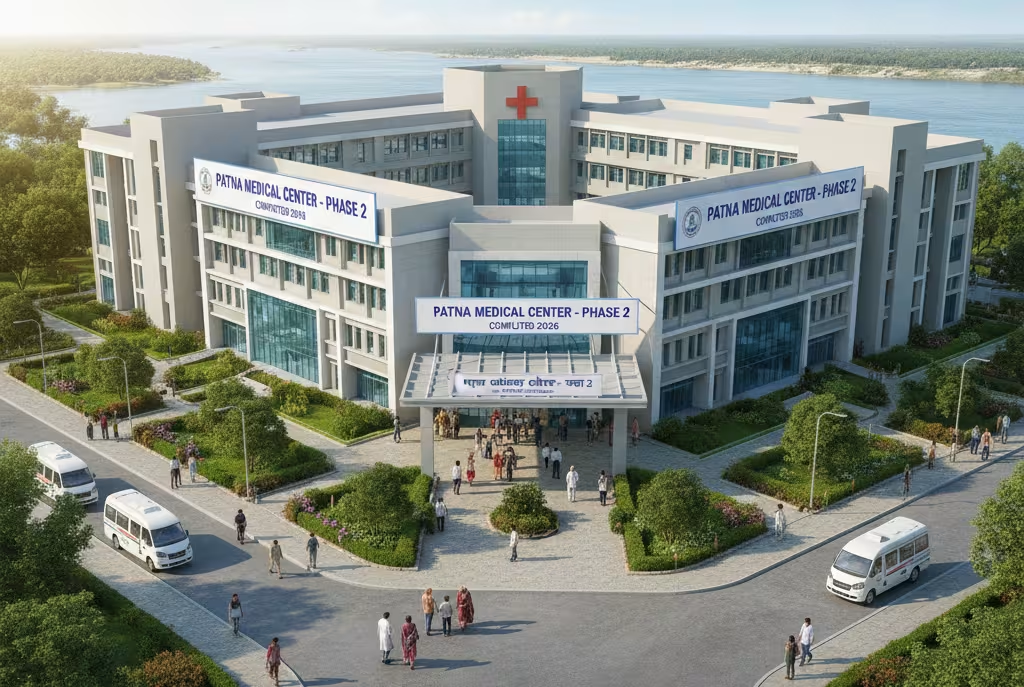
Hospital construction in Bihar can be delayed because of brickwork or manpower.
But one of the major reasons is when projects enter execution without clarity on approvals, land status, and local authority expectations.
Promoters often begin with drawings and budgets assuming timelines similar to other Tier-2 states—only to encounter approval sequencing gaps, infrastructure limitations, and interpretation variability that reshape the project mid-way.
This guide explains the real approval landscape, realistic timelines, and planning constraints for hospital construction in Bihar—so decisions are based on foresight, not course correction.
For healthcare projects, delay is not just a cost issue. It directly impacts:
In Bihar, most hospital overruns originate before construction begins not during execution.
Know the cost of construction of your hospital project
Before approvals, drawings, or cost estimates are discussed, hospital feasibility in Bihar is shaped by ground-level planning constraints that are often underestimated during early project planning.
These constraints rarely appear in DPR summaries but directly influence approvals, timelines, and buildable capacity.
One of the most common early-stage risks in Bihar hospital projects is land that is technically available but procedurally non-compliant.
Typical issues include:
Planning impact:
Land clarity frequently becomes the first silent timeline risk — often delaying layout approvals, Fire NOC processing, and even DPR validation before design development formally begins.
Many hospital sites in Bihar operate within constrained or underdeveloped infrastructure contexts, which directly shape planning decisions.
Common constraints include:
Planning impact:
These limitations influence:
Ignoring these early often results in post-sanction redesigns.
While hospital planning norms are formally standardised, their interpretation varies significantly at the local authority level across Bihar.
In practice:
Planning impact:
Identical layouts may receive different observations depending on jurisdiction.
Early alignment with local authorities is critical to avoid approval loops and mid-design revisions.
Hospital Expansion Guide for beginners
Hospital projects require multiple, overlapping approvals, often involving parallel departments.
Important: These approvals are not strictly sequential. Misjudging their order often leads to idle months.
How to design Emergency, ICU, OPD layout in Hospital in 2026
Indicative approval timelines discussed at concept stage are often optimistic and rarely reflect district-level processing realities in Bihar.
Delays in Bihar hospital projects rarely stem from execution alone.
They are usually triggered by early planning decisions that ignore how approvals and licensing actually function on ground.
Finalising layouts before validating fire access, setbacks, and service zoning frequently leads to mid-design revisions.
Why this causes delays: Approval observations often require reworking cores, circulation, or basements — resetting drawings already submitted for sanction.
Elements such as:
are site-specific interpretations, not checklist items.
Why this causes delays: What works on paper may be rejected during site review, triggering redesigns and re-inspections.
In Bihar, hospital approvals are process-driven, not file-driven.
They involve:
Why this causes delays: Projects planned assuming linear, document-only approvals underestimate the time and iteration required.
Layout decisions made during planning and construction directly affect:
Why this causes long-term risk: These conflicts are rarely visible during construction but surface during commissioning and operational approvals, often forcing compromises after completion.
Read this to get full details of hospital permits and license
Experienced hospital planners do not treat approvals as a downstream activity.
They embed approval logic into design and execution strategy from day one, reducing redesign cycles, approval friction, and commissioning delays.
In practice, this execution-led, approval-aware planning model is typically delivered by integrated design-build teams rather than fragmented consultant structures.BuiltX applies this approach in hospital projects by aligning feasibility, approvals, design, and phased execution under a single responsibility framework, helping projects move faster from sanction to construction with fewer redesign cycles.
Once statutory approvals and sanctions are secured, hospital construction timelines in Bihar tend to be largely predictable.
Most schedule overruns attributed to “slow execution” are, in reality, driven by late-stage design changes triggered by approval observations.
Before appointing architects, consultants, or contractors, hospital promoters in Bihar must establish non-negotiable pre-planning clarity.
These decisions directly influence approval timelines, construction sequencing, and commissioning readiness.
Promoters should confirm:
1) What is the healthcare infrastructure of Bihar?
Bihar’s healthcare infrastructure is expanding rapidly, with a mix of public hospitals, medical colleges, district facilities, and private institutions. However, gaps remain in secondary and tertiary care capacity, making new hospital projects critical for regional healthcare access.
2) What is the cost to build a hospital?
Hospital Construction Cost depends on various factors like no. of beds, city, land etc. To know more read this article: Hospital Construction Cost 2026
3) Is there a hospital construction cost calculator available?
Hospital construction costs cannot be accurately estimated using generic calculators. Costs depend on site conditions, approval requirements, service intensity, and phasing strategy. However you can get an approx idea using this Construction Calculator
4) Which is the best hospital construction company in India?
The best hospital construction company is one that understands healthcare regulations, approvals, medical planning, and execution sequencing—not just civil works. Integrated design-build firms with hospital-specific experience are better suited for complex healthcare projects. To discuss hospital planning, approvals, or execution strategy, you can connect with BuiltX for early-stage feasibility and approval-aware construction support.
5) What are the guidelines for hospital construction in India?
Hospital construction in India must comply with National Building Code (NBC) provisions, state building bye-laws, Fire NOC norms, accessibility standards, pollution control requirements, and healthcare licensing regulations. Early alignment with these guidelines is critical to avoid delays.
Hospital construction in Bihar is both viable and increasingly critical to meeting regional healthcare demand. However, success depends less on execution speed and more on ground-aware planning aligned to local approvals, site conditions, and authority workflows.
Each site behaves differently.
Each approval pathway functions on its own logic.
Projects that rely on template assumptions often encounter redesigns, approval delays, and avoidable cost escalation.
A structured pre-planning or feasibility assessment helps clarify:
before designs are frozen or budgets committed, particularly for hospitals planned in phases or backed by institutional or CSR funding.
Planning a Hospital Project in Bihar?
Before freezing layouts or committing budgets, many institutions opt for an early feasibility and approval-risk assessment to understand site constraints, approval timelines, and expansion limits.
BuiltX supports hospitals at this pre-construction stage helping teams de-risk approvals, align design with local authority expectations, and plan phased execution with clarity.