HealthCare
September 1, 2026
Hospital MEP Planning in India: A Practical Guide for Project Teams

A hospital may use the same wall block as a school, but it will ask very different things of the finished wall. A ward partition must be easy to clean and maintain; a classroom wall may need to keep afternoon heat out with little help from air-conditioning. Choosing a material because it is labelled “green” tells you very little about either job.
The useful question is whether it reduces resource use and works for the building, climate and budget in front of you. This guide compares 15 green building materials available or emerging in India, with honest cost guidance and the situations in which each makes sense.
Passive Design Strategies in 2026
Green building materials are products selected to reduce a building’s environmental impact across manufacture, transport, construction, use and eventual replacement. That might mean less cement clinker, recycled input, locally sourced earth, longer service life or lower cooling demand. A material does not automatically qualify because it is natural or contains waste. Its actual performance depends on the product, source, installation and building design. For an institution, the most useful comparison is often the finished wall, roof or floor over its service life, rather than the price of one block or bag.
The rupee figures below are indicative supplier examples or published ranges, not procurement quotations. They exclude installation and may exclude freight and taxes. Products without comparable public rates are marked quote locally; ask suppliers to price the same dimensions, specifications and delivery location.
Price check: One 600 × 200 × 200 mm AAC block occupies 0.024 m³, so a ₹3,500–5,000/m³ quote converts to ₹84–120 per block before any quote-specific additions. A ₹5–7 fly ash brick is ₹5,000–7,000 per 1,000 bricks, on the same quoted basis. These are conversions, not extra market quotes. Published examples come from BigBloc’s 2026 AAC price guide, Mohta Cement’s brick listing, Sevoke’s brick listing and JK Cement’s cement guide. Check rates again when preparing the bill of quantities (BOQ).
Design a sustainable medical campus in India in 2026
AAC is a lightweight, factory-made walling product; some formulations incorporate fly ash. Lower wall weight and useful thermal resistance make it attractive for framed hospitals and schools. A manufacturer’s published 2026 range is ₹3,500–5,000/m³. For a 600 × 200 × 200 mm block, that is about ₹84–120, as shown above. The environmental case depends on the actual mix, supply distance and wall design. Allow for compatible jointing mortar, suitable anchors and moisture detailing. Specify the required grade and request test evidence under IS 2185 (Part 3); do not assume any AAC partition meets a particular fire or acoustic rating without the tested assembly.
These bricks put a coal-combustion by-product to use in masonry. Two supplier examples list ₹5 and ₹7 per 230 × 110 × 75 mm brick, or ₹5,000–7,000 per 1,000 before project-specific additions. That is a useful starting point only if the product dimensions and performance match. Ask what the brick actually contains: IS 12894 covers pulverised fuel ash-lime bricks, while IS 16720 covers pulverised fuel ash-cement bricks. For a school boundary wall or low-rise infill, compare delivered brickwork, mortar, plaster and labour with the alternative—not just the unit price. Load-bearing use requires a structural design and verified brick strength.
CSEB is pressed from suitable soil with a stabiliser, commonly cement or lime, instead of being fired like a conventional brick. Research by the Auroville Earth Institute illustrates the embodied-energy potential of a specific local mix; those figures should not be treated as a guarantee for every project. CSEB can work well in low-rise educational or NGO buildings where soil, production skills and testing are available. There is no reliable national ₹/block figure: seek a local finished-wall quote including the press, stabiliser, curing, rejects and weather protection. Soil testing and plinth, sill and roof detailing are essential.
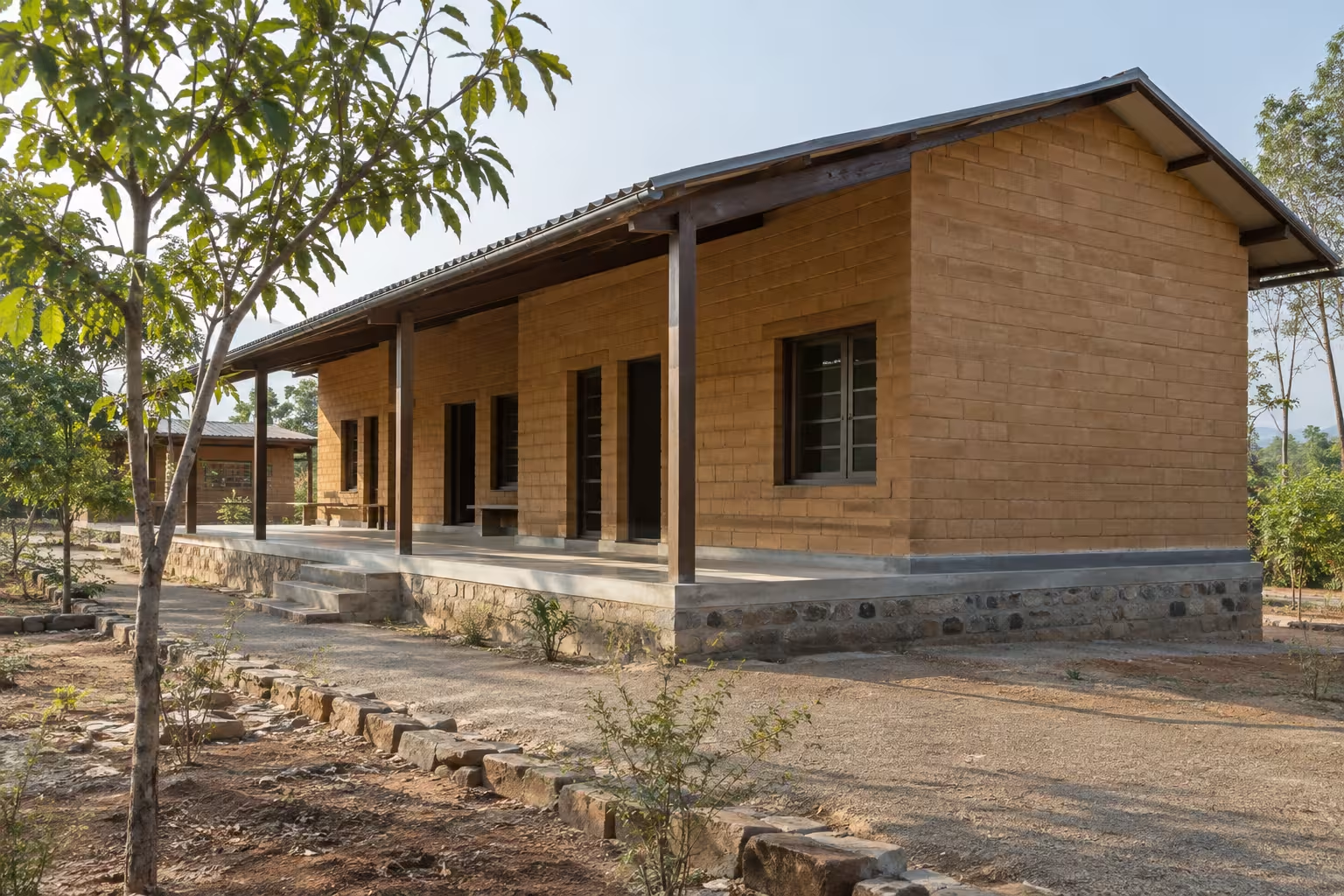
Rammed-earth walls are formed by compacting successive layers of suitable earth in formwork. Their mass can moderate indoor temperature swings, but that benefit depends on climate, shading and ventilation. They suit a sheltered campus pavilion or community space where the design can make the exposed texture an asset. Cost must be quoted per finished m² of wall, including soil preparation, formwork, labour, stabilisation if used and protection from rain. Structural and seismic design cannot be inferred from the material name. Request a trial panel before committing to a large area.
Laterite can be an appealing choice near a suitable quarry: the stone may need less processing than fired masonry, and its appearance can eliminate a separate finish. It is less convincing after a long haul or if the available stone has inconsistent strength. Obtain a delivered ₹/m³ quote plus cutting, mortar and any protective finish; a quarry-gate rate is not the finished-wall cost. Consider it for regional campus buildings and carefully detailed cladding. Ask for strength and water-absorption test results from the proposed source before specifying structural masonry.
Bamboo renews relatively quickly and can give a shaded school verandah or community pavilion a light structural system. Its service life depends on species, grading, treatment, connections and keeping water off the vulnerable details. India’s IS 15912 provides a code of practice for structural bamboo design, with defined scope and limitations; it does not make every untreated culm suitable for a building. Price the treated, graded component and installation, not a raw pole. Have the designer check loads, fire strategy, maintenance access and local approvals for the exact use.
Reusing sound doors, beams or flooring can avoid buying new material and preserve durable components already in circulation. For new timber, credible chain-of-custody documentation can support responsible sourcing. Salvaged wood needs inspection for damage, moisture and treatment history; a reclaimed label alone says little about condition. Costs differ sharply by species and dimensions, so compare a finished door, frame or m² of flooring, including restoration and finishing. This is often a better institutional application than relying on reclaimed timber for an untested primary structure.
Blending cement with fly ash or slag can reduce the clinker needed for the specified product. JK Cement’s 2026 guide gives indicative ₹360–420 per 50 kg bag for PPC and ₹370–430 for PSC. These are manufacturer-published examples, not a nationwide tender rate. For hospital or campus concrete, the engineer should select cement and the concrete mix for required strength, exposure and construction programme. Some blends develop early strength differently, so curing and formwork timing belong in the construction plan. For wider planning context, see BuiltX’s hospital construction cost guide.
Steel scrap can be remelted into reinforcement, but a bar’s environmental claim depends on the producer’s actual feedstock and manufacturing route. Buy steel for its specified performance first: request the appropriate IS 1786 grade, mill test certificate and traceability. Then request credible recycled-content or product-emissions evidence if the project is making a carbon claim. Compare delivered ₹/kg for the same grade and diameter. A recycled label does not change the structural engineer’s requirements, and one grade cannot be declared mandatory across all seismic projects without examining the design.
Processed concrete from demolition can replace some virgin aggregate when its quality and intended application are suitable. It is a sensible candidate for paving, sub-base and tested concrete mixes near a recycling facility. IS 383 addresses recycled aggregate categories; the correct use and proportion require project-specific testing and mix design. Ask for ₹/tonne or ₹/m³ delivered, gradation, contamination results and a trial mix. A distant recycling plant can erase the apparent savings. For structural concrete, the engineer must approve the source and design rather than rely on a blanket “recycled aggregate is safe” claim.
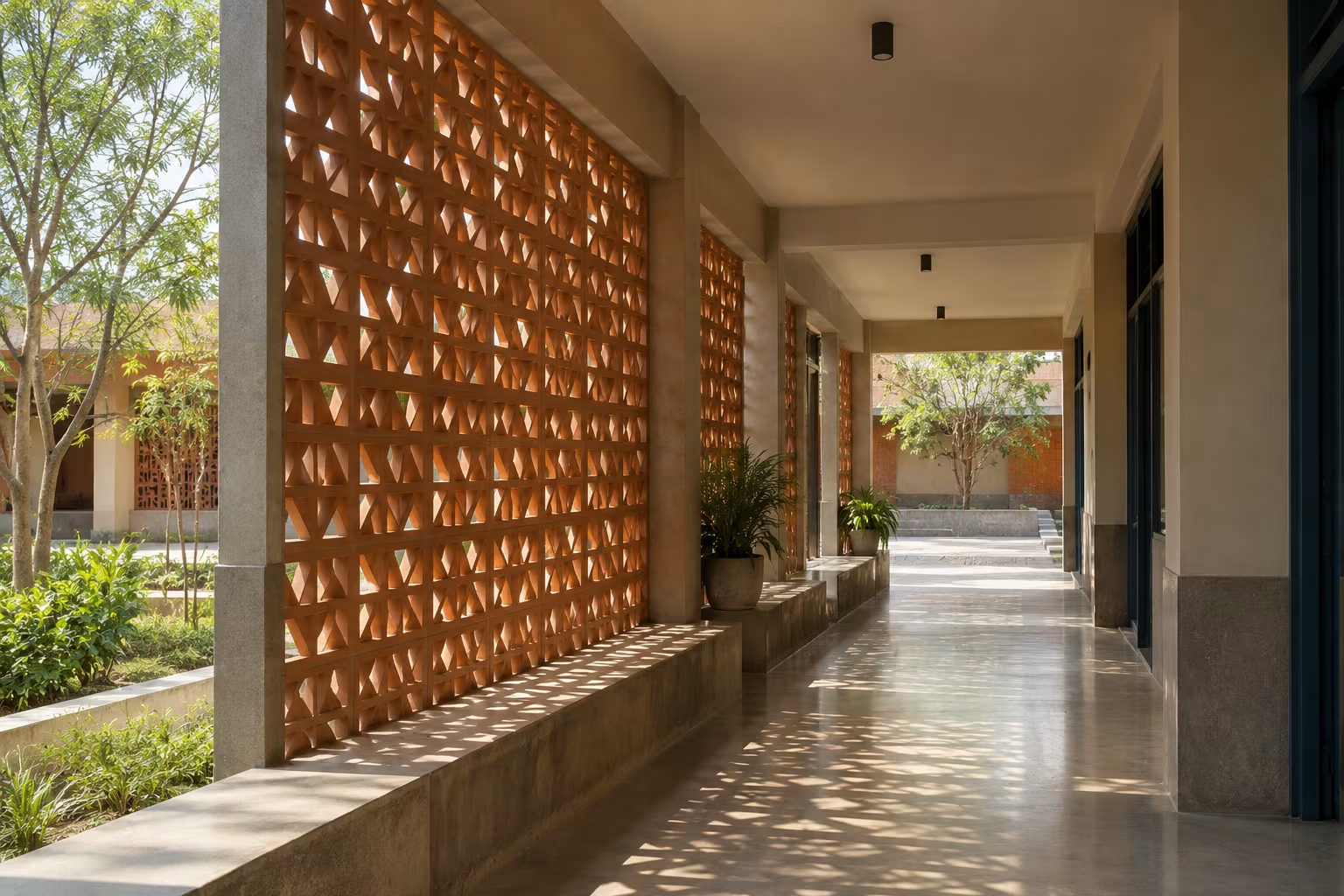
Hollow clay units use a different geometry from solid brick; terracotta screens can shade openings while admitting light and air. They are particularly useful for corridors, courtyards and other naturally ventilated parts of a campus. Their benefit comes from the whole façade design, not from calling fired clay inherently low carbon. Compare ₹/m² of completed wall or screen, including support framing. Check breakage, rain penetration, cleanability and the need for insect control; a ventilated screen is rarely appropriate as the only enclosure to a controlled clinical room.
A reflective roof limits absorbed solar radiation and can improve comfort beneath an exposed roof. India’s Bureau of Energy Efficiency describes cool-roof performance in terms of solar reflectance and thermal emittance. For a school or hospital extension, request the product’s tested performance, compatibility with waterproofing and the expected cleaning or recoating schedule. Compare ₹/m² installed, including surface preparation. The energy benefit varies with climate, roof insulation, building operation and the roof’s condition over time.
Precast wall or floor components can limit site waste and shorten work in a live institutional campus. If the specified mix uses PPC, PSC or other suitable cementitious additions, there may also be a material-related benefit. Neither outcome follows automatically: a heavy panel shipped a long distance or an unsuitable connection detail can undermine the case. Ask for a ₹/m² installed price covering lifting, joints, transport and finishes. It works best where modules repeat and the architect, structural engineer and services team can coordinate openings early.
For wards and classrooms, finish selection affects indoor air quality as well as cleaning and maintenance. The IGBC Green Interiors guide includes criteria for low-emitting materials, including paints and coatings. Request the specific product’s VOC data, finish performance and cleaning compatibility. Compare ₹/m² applied for the required number of coats, rather than assuming a fixed price premium for all low-VOC paints. A low-VOC label alone does not establish infection-control suitability or replace ventilation.
Bio-based panels can use crops or agricultural residues and may offer insulation, but product formulations and supply chains differ widely. They are worth evaluating in a demonstration pavilion or non-critical interior before adoption across a hospital or school. There is no defensible single Indian market rate for the category: request a ₹/m² installed pilot quote, product tests, fire and moisture data, replacement plan and evidence for any carbon claim. Do not use a promising laboratory result as a substitute for an approved building specification.
Start with the room and its duty, then shortlist materials. A hospital ward might justify a robust, low-emission, cleanable finish; a naturally ventilated school may gain more from an effective roof and shaded openings. An NGO building far from a major city may benefit from locally made masonry if consistent testing and skilled supervision are available. BuiltX’s sustainable hospital design guide and sustainable architecture guide explain how these choices fit into wider design and operating costs.
Before approving a substitution, ask the project team five questions:
10 ways to achieve sustainaible design in India in 2026
There is no universal cheapest option. A locally supplied fly ash brick may have a low unit price, while AAC could give a competitive finished wall once labour and supporting work are included. Compare equivalent assemblies on the same site.
At a published supplier range of ₹3,500–5,000/m³, the mathematical equivalent is ₹84–120 per block because its volume is 0.024 m³. The actual supplier quote can differ by grade, distance, quantity and taxes.
They can be considered only when the proposed bricks have the required test results and the wall is designed for the project’s loads and conditions. A claim that all fly ash bricks are suitable for a particular number of storeys is unreliable.
Potentially, with suitable soil, stabilisation, curing and carefully designed plinths, overhangs and finishes. Rain exposure and maintenance must be considered early; a local mock-up and testing are prudent.
There is no single hospital material. AAC or tested masonry may suit partitions; suitable blended cement may serve structural work; and verified low-emission, cleanable finishes can support occupied interiors. Clinical and service requirements decide what can be used in each room.
No. Its unit price may be lower while freight, detailing or specialist labour cost more. Compare first cost and expected maintenance or energy costs for the same functional outcome.
The value of a green building material depends on where and how it is used.
A low material price cannot compensate for long-distance transport, poor installation, unsuitable performance or high maintenance costs. For hospitals, schools and NGO facilities, the right decision comes from comparing finished cost, durability, climate suitability and building requirements before materials are written into the design and BOQ.
BuiltX helps institutional owners evaluate material options alongside functional planning, project budgets and long-term building performance.
Planning a hospital, school or institutional campus?